Trullo Construction — Dry-Stone Conical Roofs of Apulia
Origin: Apulian Italian (Itria Valley, southern Italy)
Round single-room dwellings with corbelled limestone domes built without mortar in the dry stone tradition of southern Italy.
Background & Cultural Context
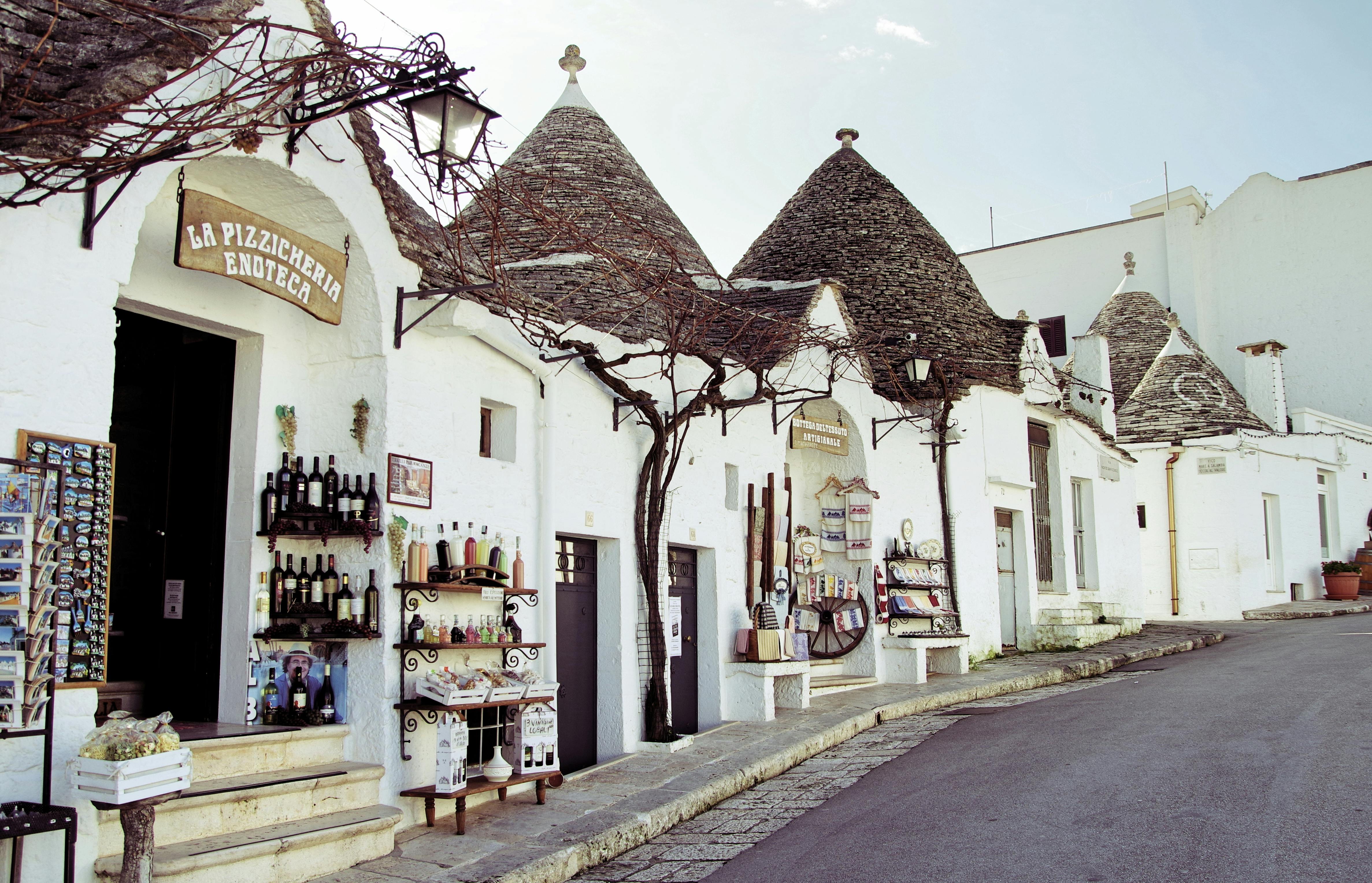
The trullo is a single-room dry-stone dwelling with a conical corbelled roof, native to the Itria Valley of Apulia in southeastern Italy. The form is most closely associated with the town of Alberobello, a UNESCO World Heritage site since 1996, where roughly 1,500 trulli stand in dense settlement on two adjacent hillsides. Trulli also dot the surrounding countryside in smaller numbers across the Murge plateau. The earliest documented trulli date to the fourteenth century, though the corbelled dry-stone construction technique they use is far older and is found across the Mediterranean from Sardinia (nuraghi) to the Balearics (talayots) to Mycenae (tholos tombs).
Construction uses locally quarried limestone. Walls are built double-skinned, two parallel courses with smaller rubble packed between them, typically eighty to one hundred twenty centimeters thick at the base and tapering as they rise. No mortar is used in the structural shell. The roof is built as a corbelled vault: each course of stones overhangs the course below by a few centimeters, and the courses gradually close to a single capstone at the apex. The cone is finished externally with a second layer of larger flat stones called chiancarelle, set with a slight outward pitch so rainwater sheds without penetrating to the inner shell. A whitewash of lime is applied to the cone for waterproofing and solar reflection.
The historical explanation most commonly offered for the dry-stone construction is taxation. Under the Kingdom of Naples in the fifteenth and sixteenth centuries, taxes were levied on permanent dwellings, and a structure that could be quickly dismantled by removing the capstone (causing the cone to self-collapse) was treated as temporary and untaxed. Whether this story is fully accurate or partly folklore, dry-stone construction was certainly the regional norm and would have been the chosen method for any tax-conscious household. The earliest mortared trulli appear in the late nineteenth century as the tax-evasion incentive disappeared.
Many original trulli carry painted symbols on the chiancarelle of the cone — Christian crosses, zodiac signs, agricultural icons, ancestral marks. The symbol vocabulary is recorded by the Apulian ethnographer Angelo Tursi in his 1971 study of Alberobello inscription. The symbols read as a partial household genealogy and have parallels in the marks on Sardinian shepherd huts and Cycladic chapels.
The interior plan is also distinctive. A typical single trullo encloses approximately twenty square meters of floor area under one cone. Larger family houses are built as clusters of three or four cones linked by short connecting passages, each cone containing a discrete room (sleeping, cooking, storage, animal pen). The interior surfaces are lime-plastered white. Small windows are kept to the minimum, the cone interior often left exposed as decorative structure. Olive-oil lamps and the wood-fired hearth (integrated into one trullo of the cluster) provide interior light and cooking heat. The thermal mass of the limestone walls evens out the Apulian summer-winter swing and the buildings are still used as summer holiday and farm dwellings today.
Modern Application
Building a trullo today is feasible in any rural site with abundant flat limestone or comparable bedded stone, and remains a practical option for off-grid storage buildings, garden pavilions, and small dwellings. The corbelling skill is taught in dry-stone walling workshops in Apulia and in the Dry Stone Walling Association programs in Britain. A trained dry-stone waller working alone takes about two hundred fifty person-hours to build a five-meter-diameter trullo from site-sourced stone; with a small crew the project compresses to two to three weeks.
Thermal performance is excellent in hot dry climates. The thick stone walls give the building a thermal time constant of roughly twelve to sixteen hours, so interior temperatures lag the diurnal extremes and oscillate within a narrow band. Apulian summer days at thirty-five degrees Celsius see trullo interiors at twenty-two to twenty-five degrees with no mechanical cooling. Winter performance is reasonable but single-room and well-insulated heating with a small wood stove is the historic norm.
Modern adaptations: many newly built trulli in the Itria Valley today use mortared limestone for the wall structural shell (faster, more code-compliant) while keeping the traditional dry-stone corbelled cone for the roof. The visual continuity with the heritage buildings is preserved while permitting and insurance issues are simplified. For garden pavilions and tool sheds the fully dry-stone construction is generally permissible under farm-outbuilding exemptions in most European jurisdictions.
Honest limits: dry-stone construction is not approved as habitable dwelling under most modern building codes outside the Apulian heritage districts; structural-engineer verification is needed for permitted occupied builds. The form does not perform well in seismic zones — corbelled vaults are vulnerable to horizontal acceleration — so seismic-zone builds need stainless reinforcement that the historic trulli do not have. Restoration of existing trulli is well-supported under Italian heritage law and is a specialty trade in the Itria Valley; trained restorers from the Alberobello guild publish maintenance manuals and run apprentice programs that have kept the skill alive.
Buying and restoring an existing trullo in Apulia is an established tourism and second-home market. Listed trulli sell from approximately fifty thousand euros for an isolated countryside building needing full restoration to one and a half million euros for a restored cluster with land. Restoration projects typically require an architect specialized in Apulian vernacular and a registered stone-mason team; the work is supervised by the Soprintendenza Belle Arti, the regional heritage office, which sets limits on additions and material substitutions to protect the historic fabric.
Sources & Citations
- Pagano, G. and Daniel, G. (1936). Architettura rurale italiana. Hoepli (reprinted 1995).
- Allen, E. (1969). Stone Shelters. MIT Press (Mediterranean vernacular survey).
- Tursi, A. (1971). I segni dei trulli di Alberobello. Schena Editore.
- UNESCO World Heritage Centre. The Trulli of Alberobello, inscription 1996, reference 787.
Do you know a solution from this tradition that should be in the archive?
Contribute a solution